Run your Epicor supply chain on live, drillable reporting.
Demand, purchasing, inventory and production — a deep library of ready-built supply chain reports covering supplier performance, stock, material availability, jobs, GRNI and margin. Open one, change a filter, drill to the Epicor transaction behind any number.
Cloud or on-premise · Excel & web access · Running and trained in 8 hours
Live, drillable reporting from supplier to customer — purchasing, inventory, production and delivery — built for the teams managing performance, cost and service as it happens.
Buyers, planners, production leads and site managers open their own report in Excel or the browser — no BAQ to write, nothing to ask IT for.
From an actionable summary report back to the source Epicor transaction — every time.
Job closure fails when a transaction across modules is late or missing.
A job touches inventory, production, costing, subcontracting and finance. FastClose gives the job closing process a control layer that makes status and WIP impact clear before the job gets stuck.
Supply chain reporting is fundamentally different from FP&A.
Supply chain reporting runs the business day to day. FP&A analyses the financials and plans what happens next. FastClose does both — but they aren't the same thing, and treating them as one is how supply chain visibility gets lost.
Consolidate unposted COS and WIP with the posted GL, live.
FastClose reads unposted capture transactions directly from Epicor and consolidates them using the same logic as posted financials — so the P&L reflects the real position mid-month, not just at period end.
See the full operational and financial position at any point in time, not only at period end.
Start at group-level margin or cost, then drill by business unit, product, customer and project to the source posting.
Supply chain and financial data unify, supporting stronger governance, reconciliation and auditability.
Supply chain reports people request
These are the ones customers bring up first — not because they're clever, but because they're the ones they need but never had before.
Job closing
Which jobs are ready to close, what is still sitting in WIP, and how actual labour and material compare with estimate — before the job is closed rather than after.
Time-phased reporting
Demand, supply and committed spend spread across the periods they actually fall in — so a forward view is a report, not a spreadsheet somebody rebuilds each month.
On-time-in-full delivery
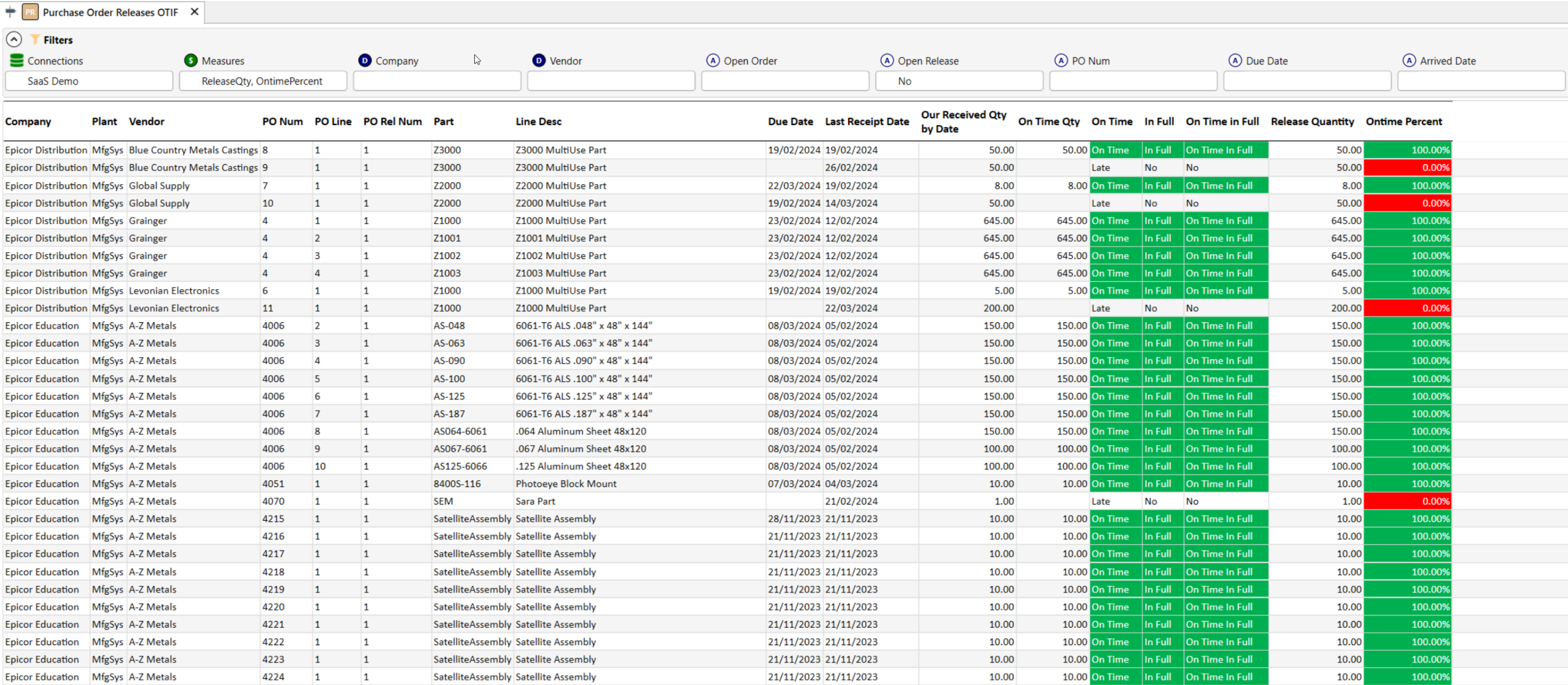
How do your suppliers meet their promise to you? Do they deliver components on time and in full? Reported by supplier, product and site, measured against promise dates — with the ability to drill into the lines that missed and see why. Then the same question the other way around - are you meeting your promise to your customers?
Material availability
What items are short, for which order or job, and when are they due in — the question production planning asks every morning and finance asks at quarter end.
GRNI
Goods received not invoiced, reconciled line by line with drill to the receipt and the PO — the reconciliation that usually eats a day of every close.
Stock reconciliation
Inventory movement tied back to the stock accounts in the GL, so a difference is found in the period it arose rather than at year end.
Instead of waiting for a BAQ.
Supply chain questions arrive faster than IT can answer them, so the backlog grows and people work off exported spreadsheets in the meantime. FastClose puts the structure in front of the person with the question.
Existing BAQs don't go to waste either — FastBAQ imports them, and native SQL, as FastClose data sources so validated query logic gets reused. FastMigrate →
This depth in Epicor. Growing for other ERPs...
Everything on this page — Job closing, COS/WIP consolidation, the reports named — is Epicor content, built over years with real Epicor customers. Nextworld has some supply chain library whilst for SAP Business One, Acumatica, Business Central and SAP Business ByDesign we deliver the financial core in the first instance and then build supply chain reports out with you, for free if they're generic, as needed.
?Common questions about supply chain reporting
Is this a separate product from the financial reporting?
No. It is the same engine reading more broadly into Epicor. A job closing report and a management P&L are built the same way, secured the same way and drill the same way.
How is this different from FP&A tools?
FP&A analyses the financials on a monthly or quarterly cycle, usually within a GL/AP/AR context. Supply chain reporting runs the business day to day, drilling through modules to the source transaction. FastClose covers both, but they answer different questions.
How long does deployment take?
Installed in under an hour, and teams are typically up, running and trained within 8 hours — on cloud or on-premise Epicor alike.
Who uses supply chain reporting in practice?
Supply chain, operations and production managers, buyers, planners and commercial teams — alongside finance, who need the same data to explain the numbers. Access is set by ERP dimension, so each sees their own site, warehouse or product group.
Can we report on our own custom fields and tables?
Yes. Customisations and user-defined fields can be brought into reporting, and an existing BAQ or native SQL can be converted to reports based on standard FastClose templates with FastBAQ.
Which ERPs have this supply chain content today?
Epicor is the deepest. For other supported ERPs, where the supply chain content would be common to similar businesses, it is built out with you at no cost.
Bring the report nobody can get you.
We'll build it live against your Epicor data on the call.